
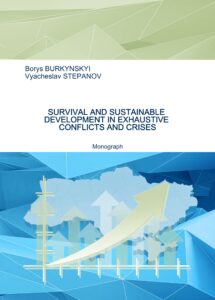
 Survival and sustainable development in exhaustive conflicts and crises : monograph / Borys Burkynskyi, Vyacheslav Stepanov ; National Academy Of Science Of Ukraine, State Organization «Institute Of Market And Еconom-ic&Ecological Researches Of The National Academy Of Sciences Of Ukraine». – Odesa : SO «IMЕER of NAS of Ukraine», 2023. – 134 с.
ISBN 978-617-14-0032-0
This work addresses the topical issue of sustainable development of socio-economic systems under conditions of a high level of uncertainty and risks, including those associated with military aggression. Issues of conflicts and crises are considered in terms of modern paradigms of riskology, conflictology and geopolitics. The new content of the categories “exhaustion”, “survival”, “stability” as categories of the theory of development of complex systems is revealed. Particular attention is drawn to the issue of compromises as a tool for solving complex problems and the axiological (valuable) dimension of the issues under study.
Reviewers:
A. I. Kovalev – Rector of the Odessa National Economic University, Doctor of Eco-nomics, Professor
S. A. Yakubovskyi – Head of the Department of World Economy and International Economic Relations, I. I. Mechnikov National University, Doctor of Economics, Professor
Printed by the decision of the Academic Council
State Organization «Institute Of Market And Еconomic&Ecological Researches Of The National Academy Of Sciences Of Ukraine»
(minutes No. 19 dated 12/16/2022)
CONTENTS
FOREWORD | 5 |
INTRODUCTION | 11 |
І. ISSUES OF SOCIO-ECONOMIC SYSTEMS SURVIVAL AS A SUBJECT OF COGNITION AND MANAGEMENT | 15 |
1.1. Depletion of socio-economic systems as a modern challenge | 15 |
1.2. Survivability as a category of sustainable development theory | 21 |
1.3. Driving forces for survival and sustainability | 27 |
ІІ. IMPERATIVES OF SUSTAINABILITY OF THE DEVELOPMENT OF SOCIO-ECONOMIC SYSTEMS IN THE CONDITIONS OF THE CRISIS | 35 |
2.1. Strategic imperatives for sustainable development in times of crisis | 35 |
2.2. Imperative parameters of order in the system of sustainable development | 41 |
2.3. European order parameters in the context of interests of sustainable development of Ukraine | 47 |
2.4. Socialization and noospherization as a higher order factor in the development of society | 51 |
2.5. Formation of a new global order as a factor of survival and sustainable development | 53 |
III. COMPROMISES AS TOOLS FOR SOLVING CONFLICT AND CRISIS PROBLEMS | 58 |
3.1. Conceptual-categorical interpretation of compromise | 58 |
3.2. Classification of compromises in the context of public conflicts and crises | 62 |
3.3. Criterial measuring of compromises | 70 |
3.4. Negotiations as a tool for finding compromises and conflict resolution | 73 |
IV. AXIOMATIC (VALUABLE) MEASURING OF ISSUESOF SURVIVAL AND SUSTAINABILITY DURING CRISES | 79 |
4.1. Human-Oriented Imperative Values | 79 |
4.2. National values in the context of survival and sustainable development | 82 |
4.3. Problems of measuring the values of socio-economic systems | 86 |
CONCLUSION | 90 |
REFERENCES | 96 |
Glossary for The Theory of Survival and Sustainable Development | 107 |
Subject index | 130 |
FOREWORD
Modern world is developing in conditions of unprecedented changes in society and nature. Deepening crisis is acquiring a planetary character. This global phenomenon is defined as a “planet and mankind are in danger”, “world bursting at the seams” , etc. Many countries, including Ukraine, which is defending its territories and sovereignity from Russian aggression, are in conditions of exhausting confrontation and the need for survival.
As a result of reserch of the problems of survival and development under conditions of exhausting conflicts and crises we deloped the concepts of “exhaustion”, “survivability of the system”. They are considered as categories of theory of development and theory of management of complex systems.
In this context, the concept of “exhaustion” is interpreted by the authors as the state of the system (socio-economic, economic-environmental, etc.), which is expressed as follows:
- a) decrease of the functional ability and activity of individual subsystems or the entire system as a whole, due to the impacts of excessive irritants, including military actions;
- b) resource depletion of the system (for example, in recent years more and more attention has been paid to the problems of the depletion of natural resources of certain regions, countries and the planet as a whole, including strategic resources (oil, gas, etc.);
- c) decrease of the functional efficiency of system management.
The concept of “survivability of the system” is considered as:
- a) ability of the system to withstand the processes of its depletion in crisis conditions;
- b) ability to withstand disbalances of economic and other components, as well as any external influences without development of processes of degradation, disintegration or transition to a qualitatively different state in the system;
- c) complete reliability of the system, defined as a fundamental characteristic that allows the system to function and survive.
The work examines the driving forces of survival and sustainable development of the socio-economic system, which include:
ideal motivations and factors – general civil national idea, spirit of the nation, political concepts;
material driving forces – economy and activation of the development of science and scientific and technical activity;
specific driving forces – consolidation of our society and unity of the people, society’s ability to find internal and external compromises, ability to negotiate, society’s ability and willingness to pay a high price for human well-being (preserving life and health, protecting rights and freedoms).
The work formulates a system of strategic imperatives for the sustainability of the development of socio-economic systems in the conditions of exhausting conflicts and crises, which include:
- a) “human life is above all”;
- b) “peace is above all” (the ideal option is “peace at any price”, which in real conditions, as a rule, is often very problematic);
- c) integral (socio-economic-ecological) imperative – compliance with the laws of the diversity of system elements as a leading factor in the sustainable and effective development of both the natural and social systems;
The work examines the imperative parameters of order in the development of the world community in relation to the interests of survival and sustainable development of Ukraine, as well as the problems of socialization and noospherization as factors of the highest order in the development of modern society.
Authors considered it necessary to pay special attention to the issue of theoretical and methodological understanding of the problem of compromises as an important tool for solving modern conflict and crisis problems that have engulfed the modern world.
In this plan, the issue of conceptual and categorical interpretation of compromises is discussed, in particular, compromise is considered as:
resolution of the conflict by mutual and voluntary agreement with mutual rejection of part of the demands made to the object of the conflict;
a reasonable way of balancing conflicting interests, which is defined as mutual management of the conflict object;
manifestation of courage and respect for opposing positions;
reflection of the essence of democracy;
compromise is not capitulation, but a higher level of manifestation of the intelligence of the conflict subjects.
In this scientific work, the problems of compromises are considered as a new scientific direction of management theory, which is defined as compromiseology. Within the framework of this scientific direction, the authors formulated some basic methodological preconditions and developed:
- a) classification of compromises in the context of social conflicts and crises, as well as the corresponding ideologues of the security of Ukraine;
- b) system of criteria for reasonable compromises in solving the tasks of managing social development in conditions of conflicts and crises.
Authors associate the success of solving complex conflict problems based on the search for compromise solutions with the mathematical analogy of solving differential equations, the prerequisite for which is the task of choosing the lower and upper boundary conditions.
In solving the tasks of finding acceptable compromises, the number of which can be infinite, it is necessary to choose the lower and upper boundary conditions in accordance with the interests of national security and national values of Ukraine.
Taking into account that at the current stage of aggravation of socio-economic, economic-ecological and other problems, issues of value (axiological) understanding of them in the context of survival and sustainable development are gaining more and more importance. In this work, the issue of the value dimension of the considered problems is discussed in the production plan. In this case, in the conceptual and categorical sense, national values are considered:
- a) ability of society and the state to ensure the protection of life, health, and well-being of people, including in crisis conditions;
- b) ability of people and state to adapt new conditions and adequately respond to emerging dangers;
- c) ability of the socio-economic system to survive, as well as the ability for sustainable development and effective management.
In the axiological sense, the authors consider the national values of Ukraine in a three-dimensional plan:
1) spirituality of a civil nation as a function of the high organization of society; as a result of socio-historical practice; as stability of the people and the state in difficult periods of adversity, crises, war;
2) quality of life of the people (state) as a fundamental concept of survival and sustainable development;
3) creative ability (creativity) of Ukrainian people which is a conscious, purposeful, creative activity of people for the benefit of their people, society, their country.
The expert-level assessments of the problems of national values from the standpoint of an integrated approach serve as the basis for developing responses to modern challenges, primarily those related to international crises, war, as well as Ukraine’s special mission in Europe and in the world. The richest potential of Ukraine’s national values is the key to its successful development and mission, which includes:
- a) ability of organized opposition to internal and external aggression as a consolidated political nation;
- b) rich natural resource and technological potential, which allow to successfully solve the most acute problems of food security in Europe and the world in general.
The authors of this work draw attention to the exceptional complexity and non-linearity of the discussed issues. In particular, the authors emphasize that the complexity of the state organization and management system should fully correspond to the nonlinearity of the managed complex system.
Compliance with this postulate in the conditions of exhausting conflicts and crises should be considered as a categorical imperative of management.
Large systems as the state should be considered as a complex, developing system that changes in the space of factors and time. From the point of view of modern science (physics, nonlinear dynamics, synergetics), such a system is clearly nonlinear.
Given the widely used physical meanings of “weak” and “strong” interactions, the nonlinearity of complex systems (in particular, state) can be considered both weak nonlinearity and strong nonlinearity.
One of the indicators of weak non-linearity of the state is the quasi-linear simplified basis of management. According to the laws of nature, primarily biology, natural systems with a low level of diversity (biodiversity) are less resistant to various and inevitable stresses and less viable in conditions of anthropogenic influences.
Certainly, natural and public (social) systems with a high level of diversity in organization and management, which are characterized by strong nonlinearity, are much more resistant to stress and have a higher potential for survival and development efficiency.
Based on the above, the following conclusions were made:
1) modern state and its economic system in conditions of increasing tensions and stresses is an extremely complex, developing and non-linear system. Non-linearity reflects the high meaning of its survivability and sustainability of development;
2) only a strong non-linearity of the socio-economic system (state) can allow:
- a) adapt flexibly, survive and thrive in increasingly difficult competition and increasing obstacles;
- b) gently and effectively use the tools of non-linear compromises in the management of complex conflict and crisis problems.
This work is intended for a wide range of readers – researchers and teachers, as well as those who are interested in topical modern problems of survival and sustainable development.